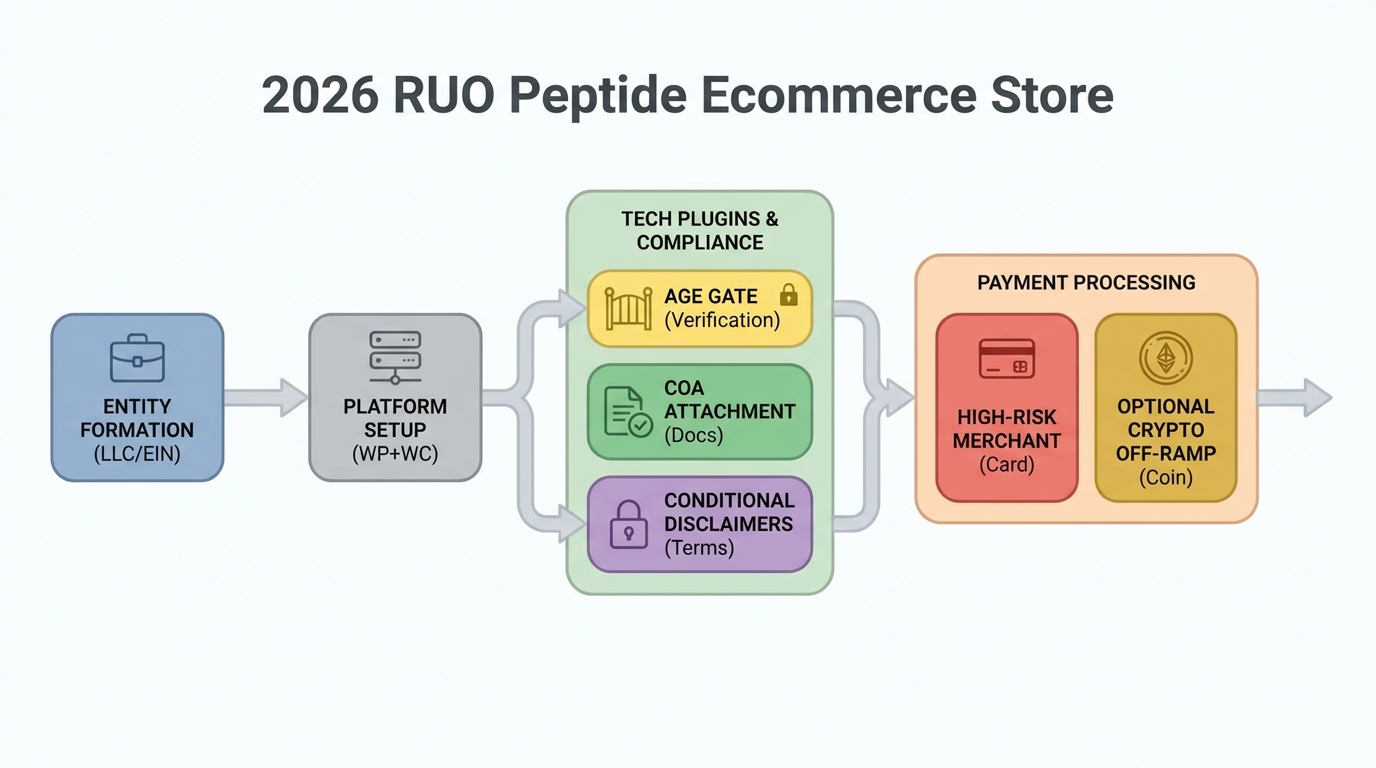
If your peptide store just got shut down, run three tracks today: document the suspension and request a written fund-release statement; export every asset you can still reach; and stop sending paid traffic to a failed checkout while a replacement stack is prepared. Do not open a look-alike account to get around the termination. The recovery is not an appeal sprint. It is a records, payments, fulfillment, and storefront migration project.
The first mistake after a shutdown is treating it as one problem. A platform suspension, a merchant-account termination, and a processor hold can happen together, but they are separate failures with separate owners. Your storefront may be inaccessible, your card processing may be disabled, and your funds may be held under the merchant agreement. Handle each track in parallel.
What actually got shut down?
Start by identifying the exact layer that failed. A commerce platform suspension means the storefront software or hosted account is unavailable. A payment processor termination means the company that routed card transactions has stopped processing for your business. A merchant identification number, or MID, is the account identifier assigned to your business by the acquiring bank, the bank that accepts card transactions for the merchant.
That distinction matters because a working storefront without a processor cannot take card orders, while an active processor cannot help if your product catalog, customer records, and domain are trapped inside a suspended platform account.
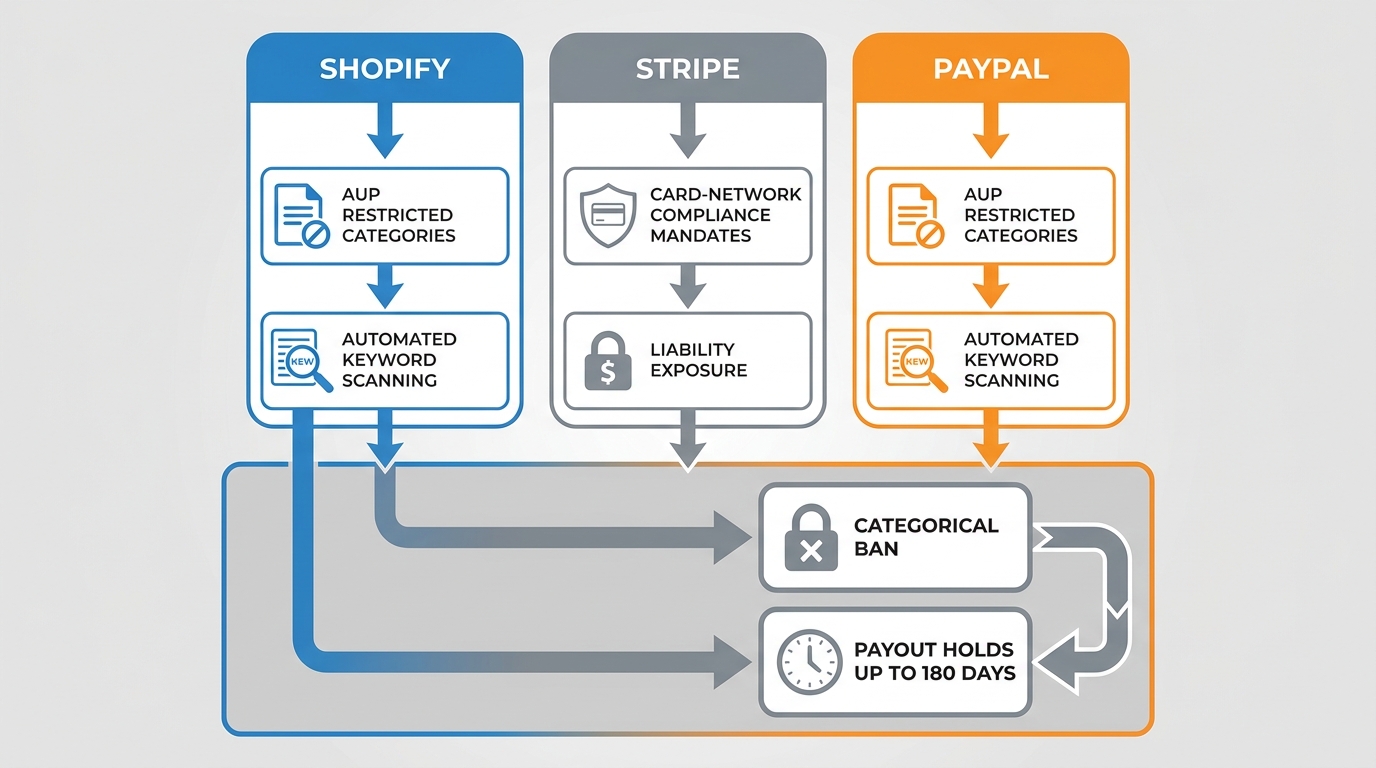
The email usually says some version of “your store violates our Acceptable Use Policy” and provides very little useful detail. That is normal for a policy-driven closure. Shopify’s Acceptable Use Policy is the document behind many storefront review notices, while Stripe’s Restricted Businesses page is part of the category screen merchants encounter when applying for card processing. Neither document is a negotiation framework. They are risk controls for the platform, processor, acquiring bank, and card-network chain.
Peptide catalogs draw additional review because an underwriter must assess product presentation, research-use-only, or RUO, language, fulfillment practices, historical disputes, refund handling, supplier documentation, and the business’s ability to support cardholders after a purchase. RUO language matters, but it is not a shield by itself; reviewers look at the full product presentation and evidence of intended use, not just a disclaimer. A clean-looking theme does not solve a mismatched risk profile.
By 2026, this was not a theoretical problem. Peptide Sciences went offline on March 6, 2026, which made category risk feel very concrete for operators still relying on a single platform or a single processor.
What should happen in the first 24 hours?
Pause paid advertising immediately if checkout is unavailable or unreliable. Google Ads, Meta, TikTok, affiliates, and email campaigns can all keep sending traffic after a shutdown. That creates wasted spend, abandoned carts, confused customers, and preventable support volume.
Next, preserve the suspension notice, account emails, processor dashboard screenshots, payout history, recent settlement reports, dispute reports, and merchant agreement. Save them outside the affected platform. Use a simple folder structure with dates, then keep a written event log: when the notice arrived, what system stopped working, what funds appeared available, and every communication sent or received.
Pause every campaign that links directly to a broken checkout.
Confirm whether the storefront, processor, domain, fulfillment account, or all four are affected.
Save the termination or suspension notice as a PDF and screenshot the account dashboard.
Record the processor’s stated reason exactly as written.
Check whether orders placed before the shutdown are still in the fulfillment queue.
Give fulfillment staff and any third-party logistics provider, or 3PL, a current list of orders that may ship, pause, refund, or require review.
Do not let fulfillment run on guesswork. A payment hold can create uncertainty around captured orders, refunds, and duplicate shipments. Reconcile open orders against payment status before releasing inventory. Your customer-support inbox should use the same order status list as your warehouse or 3PL.
Never keep spending traffic against a checkout you cannot support. A quiet pause is cheaper than a week of preventable disputes.
How do you protect held funds?
Ask the terminated processor for a written statement covering the current held balance, reserve amount, expected release schedule, and any stated conditions that affect release. A rolling reserve is a portion of transaction proceeds withheld by a processor to cover possible refunds, chargebacks, or losses. While many high-risk accounts see holds in the 90- to 180-day range, your actual release period and calculation method depend on the merchant agreement and account history.
Use calm, factual language. The goal is a paper trail, not a dramatic appeal. A useful message can be as simple as:
Subject: Request for Written Balance and Reserve Release Schedule
Please confirm the current held balance, the amount identified as reserve, the expected release schedule for each amount, and any conditions stated in our merchant agreement that affect release. Please also provide the current status of open disputes, pending refunds, and recent settlements.
Keep the request focused on account records. Do not create conflicting explanations across support tickets, emails, and applications. If the held amount is material to the business, an attorney with merchant-agreement and payments experience can review the contract and correspondence for your specific situation.
Avoid the “new entity, same processor” reaction. Some merchant agreements characterize attempts to reopen under related ownership, a related domain, or a new entity as circumvention. Mastercard’s MATCH list, short for Member Alert to Control High-Risk Merchants, is an acquiring-industry alert system used in merchant-risk decisions. Changing the company name does not automatically remove the ownership, domain, transaction-history, or product-category facts visible to an underwriter. If a processor views the move as circumvention, it can make fund recovery harder and create new account problems at the same time.
Which business assets need to be exported first?
Export anything you can still access before platform permissions narrow further. The customer database is valuable, but it is not the only critical asset. Your replacement store will also need product copy, images, inventory records, order history, supplier documents, and the operational details that make a catalog easier to evaluate during a new underwriting review.
Customer records: Export names, email addresses, purchase history, order status, and support history in CSV format.
Product catalog: Download product names, SKUs, vial or format details, storage language, label images, product descriptions, and category structure.
COAs and batch records: A Certificate of Analysis, or COA, is the document that reports the testing information associated with a product batch. Download every COA, batch record, specification sheet, and supplier PDF from email, cloud storage, and product-page attachments.
Order and fulfillment records: Save open orders, tracking numbers, refund status, shipping labels, and inventory allocation reports.
Domain control: Confirm that you have administrator access at the domain registrar and can edit DNS records. Your domain is the traffic asset; the storefront is only the software currently attached to it.
Creative assets: Download high-resolution images, packaging photos, brand files, email templates, and every version of product copy.
Keep the COA archive organized by product, batch identifier, and date. A processor or platform reviewer cannot make sense of a folder named “final-final-new.pdf.” Neither can your support team six months later. Clear file names and a batch-to-SKU map reduce needless back-and-forth when documents are requested.
Do not claim that replacement inventory has identical COAs, batches, or specifications unless you can document that statement. If a supplier, batch, packaging run, or fulfillment location changes, update the product record honestly. Underwriters and sophisticated buyers notice when product pages say more than the documents support.
What should you tell customers during the outage?
Communicate early, but only say what is true. Do not invent a maintenance window, promise a reopening date you do not control, or describe a processor termination as a routine upgrade if orders cannot be supported. The best notice is brief, factual, and aligned with the actual order situation.
Subject: Checkout Update
We are currently unable to accept new orders through our storefront while payment infrastructure is being updated. Existing orders are being reviewed against fulfillment and payment status. Customers with an affected order will receive a direct update from support. We appreciate your patience and will publish an update when checkout is available again.
If a replacement storefront later opens, announce the new domain only after the catalog, support inbox, shipping rules, and payment method are functioning. Preserve the same support email where possible. Customers should not have to discover that their order history vanished because the company changed platforms.
Your customer records and marketing permissions also matter. Use the business’s existing privacy terms, consent records, and customer-service commitments when communicating with past purchasers. If the shutdown involves a disputed refund obligation or a business closure, qualified counsel can advise on the appropriate notice for your situation.
What does a replacement peptide storefront need?
A replacement store needs more than a new theme and a payment button. It needs a storefront you control, a product catalog that matches your documentation, a payment route with a disclosed category fit, and an operating process for disputes, refunds, fulfillment, and customer support.
There are several realistic routes. An appeal to the original platform may be worth pursuing when the provider offers a defined review process, but do not make your entire recovery plan dependent on its timeline. A self-hosted storefront gives you more control over code, catalog data, domains, and integrations, but requires technical ownership and reliable operations. A managed infrastructure route, which is what we build at RUO Commerce with self-hosted Saleor and a custom Next.js storefront, trades monthly operating cost for an operated stack that the client owns.
For payments, speak directly with any prospective high-risk provider about the product category before investing in integration. Ask whether research-use-only peptide catalogs are within its stated risk appetite, what documents are required for underwriting, how reserves are structured, what triggers manual review, and what chargeback dispute support looks like. A provider that refuses to discuss category fit before onboarding is not giving you useful certainty.
A replacement stack is easier to underwrite when the catalog and the documents tell the same story. Operators commonly use clear “for research purposes only” or “not for human consumption” language, remove dosing or disease claims, add age verification at checkout, keep ingredient disclosures accurate, and maintain organized COAs and source records. For card payments, a PCI-compliant gateway and basic card-data controls are table stakes. None of that guarantees approval. It reduces review friction.
Crypto-only checkout is not a generic escape hatch. It changes the customer experience, refund workflow, reconciliation process, and support burden. It may be part of a broader payment plan, but it does not replace transparent operating procedures or careful product presentation.
What should be rebuilt before traffic returns?
Rebuild the store in the order that reduces operational surprises: domain and DNS control first, then catalog and COA library, then fulfillment rules, support processes, payment integration, and finally marketing traffic. Test the full order path with internal checks: product page, COA link, cart, checkout, order confirmation, fulfillment notification, refund workflow, and support contact path.
Owning the storefront does not eliminate review. It gives you control over the parts of the business that should never be trapped inside one vendor account.
After a shutdown, the durable recovery sequence is simple: preserve the evidence, secure the data, communicate accurately, reconcile open orders, and rebuild on infrastructure you can operate. It is slower than opening a disguised replacement account. It is also the route that gives your next underwriter, your fulfillment team, and your customers a coherent business to evaluate.
Note: This article describes common industry practices in research-use-only peptide commerce. It is not legal advice, and it does not guarantee platform, processor, or regulatory outcomes. Operators should consult qualified counsel for their specific situation.
RUO (research use only) peptide listings get flagged when product copy describes outcomes, gives administration or schedule language, or otherwise makes a catalog page read like consumer marketing. A disclaimer does not cancel contradictory copy elsewhere on the site. The practical fix is a full content reset: factual product identity, verifiable testing data, format, handling, and consistent research-market framing across pages, PDFs, images, metadata, ads, and reviews.
Why does peptide store product copy trigger automated reviews?
If you run a peptide store, the review problem is rarely limited to the product title. Platforms, payment processors, acquiring banks, meaning the banks that sponsor merchant accounts, and automated review tools assess the total commercial context around a SKU, meaning the specific product listing: page headlines, bullet points, FAQs, image alt text, collection descriptions, search metadata, blog articles, customer reviews, social posts, and even downloadable files.
The email often says only that the store violated an Acceptable Use Policy or that the account sits outside a processor’s risk appetite, meaning the kinds of merchants and content that processor is willing to underwrite. It may not identify the individual sentence that triggered the action. That is frustrating, but it reflects how these reviews usually work: the decision is based on the cumulative impression of the store, not one isolated disclaimer.
Named marketplace rules illustrate the pattern, but you do not need a single platform-specific rule to see what is happening. Amazon’s General Listing Restrictions says listing claims must be accurate, non-misleading, and supportable, and that claims can be evaluated in product descriptions, images, and packaging. CopeCart’s published product-category restrictions also show the broad lens marketplaces and checkout platforms can apply to products associated with advertising restrictions, restricted medical categories, or age-gated sales contexts.
Review systems do not read a disclaimer as a veto over the rest of the page. A footer stating “Research Use Only” carries little weight when the page title, FAQ, product imagery, or customer comments point in another direction. That is why stores with technically correct labels still run into review friction: the listing may look compliant in one field and promotional everywhere else.
Which language patterns create the most risk?
The most damaging copy often sounds ordinary to a marketer. It is written to make the product feel useful, approachable, or easy to understand. In an RUO catalog, that same language can change the apparent intended use of the item. In plain terms, the more your page reads like outcome-driven consumer marketing, the harder it becomes to defend it as a research catalog listing.
Outcome-based marketing language
Any sentence that presents a peptide as producing a physical, biological, cosmetic, therapeutic, or performance outcome is a major review signal. This includes direct promises, softer “support” language, comparative wording, and broad positioning labels that imply what the product does outside a research setting.
The problem is not only whether the sentence is promotional. It is that the sentence turns a technical catalog listing into an intended-use statement. Marketplace listing rules focus on whether claims are misleading or unsupported, while broader ecommerce advertising standards evaluate website and social copy as part of the overall marketing representation.
A cleaner product page does not try to replace one outcome claim with a more carefully worded outcome claim. It removes the outcome entirely and returns to facts that can be documented: identity, molecular information, batch data, analytical results, format, and storage information. That is usually the dividing line between a page that sells a result and a page that catalogs an item.
Schedules, administration, and protocol-style language
Protocol language is another frequent trigger. Numeric schedules, timing instructions, routes of administration, preparation instructions connected to administration, and cycle-style recommendations make a listing read as though it is directing use rather than presenting a research product.
Even when this information appears in a hidden FAQ accordion, a downloadable guide, a blog post, or a product-image graphic, it can still be visible to crawlers, reviewers, payment underwriters, and customers. A product page does not become lower risk simply because the sensitive copy sits below the fold or inside a PDF.
Close-up of Scrabble tiles spelling ‘Health’ on a wooden table with a blurred background.
A protocol in a PDF is still storefront content when it is linked from the product page. I would treat linked documents, help articles, and image text the same way I treat the main description: if it changes the apparent intended use, it belongs in the cleanup.
RUO wording that contradicts itself
“Research Use Only” is a classification statement, not a magic phrase. A page can carry an RUO label and still create review friction if the surrounding language markets a personal outcome, describes use directions, targets a body area, or frames the item as an alternative to a regulated consumer product.
This is where many stores get caught. The product title may be neutral, the label image may be technically correct, and the footer may include a restricted-use statement. Then the collection page says the catalog is built around results, the blog explains protocols, and reviews describe personal experiences. A reviewer sees one commercial story, not four separate departments.
That is why a partial rewrite often fails. You can clean up one product page and still leave the store telling a contradictory story through navigation copy, educational content, and user-generated content. RUO works only when the full store behaves like an RUO catalog.
Testimonials, before-and-after content, and review leakage
Customer reviews can create the same problem as merchant-authored copy. A review that describes an outcome, compares results, provides instructions, or references personal use can convert a neutral catalog page into a higher-risk marketing page. CopeCart explicitly prohibits deceptive reviews and testimonials, and Amazon requires claims to be accurate and provable.
Store operators commonly treat reviews as harmless user-generated content. Under a platform or processor review, they are still visible commercial content hosted by the merchant. The same applies to imported reviews, screenshot testimonials, chat quotes pasted into graphics, and “community feedback” blocks embedded in product pages.
Before-and-after framing creates the same issue. Even if the merchant did not write the underlying claim, the page still presents an apparent result. If your goal is to reduce review friction, review moderation is not optional housekeeping. It is part of product-copy control.
Creative representation of herbal health benefits using illustrated letter tiles spelling ‘health’.
What does lower-risk peptide product copy look like?
Lower-risk copy is not vague copy. It is specific, narrow, and tied to records the business actually holds. It describes the item as a catalog product rather than trying to sell an expected outcome.
Product name and internal catalog identifier
Lot or batch number where applicable
Molecular formula, molecular weight, or sequence information where documented
Purity result only when supported by the corresponding analytical documentation
Product format and net quantity
Storage and handling information drawn from supplier or testing documentation
Certificate of Analysis (COA), meaning the analytical testing document for the relevant lot
RUO classification language only where it matches the actual product records and labeling
A factual description can state that a product is a synthetic peptide supplied in a defined format, identify the relevant lot, summarize documented analytical information, and link to the matching COA. That gives a research buyer useful catalog information without constructing a story about personal results or directions.
COA display deserves special attention. A certificate can support a factual statement about a specific batch, but it should not become a marketing attachment loaded with broad claims, promotional graphics, or unrelated use language. Keep the document matched to the lot shown on the product page, legible, and technically consistent with the product identity.
The same standard applies to images and metadata. If the visible paragraph is careful but the image text, alt text, or SEO snippet reintroduces claims language, you have not really fixed the listing. You have just moved the problem to a different field.
Which content surfaces do operators forget during a cleanup?
A product-page rewrite is useful, but it is incomplete if the rest of the store continues to send conflicting signals. Review teams and automated systems can find language outside the main description quickly.
Collection titles and collection descriptions
Homepage banners, announcement bars, and promotional tiles
Product image text and image alt text
SEO titles, meta descriptions, and URL slugs
Product FAQs and accordion content
Blog posts, educational hubs, and glossary pages
Automated email flows and abandoned-cart messages
Paid-ad landing pages and ad creative
Embedded reviews, testimonials, and social proof widgets
PDFs, downloadable guides, and supplier documents
The common failure mode is a store that cleans its visible product description but leaves old SEO pages indexed, keeps aggressive ad copy running, or imports reviews without moderation. The storefront then has a neutral front door and a dozen side doors pointing somewhere else.
Operators commonly start with a content inventory. They export product descriptions, collection copy, blog posts, page metadata, image libraries, PDFs, and review feeds into one working list. That makes it possible to locate conflicting language before a platform reviewer or processor underwriter locates it first.
If you skip this step, you usually end up in a loop: one team edits the product page, another team keeps the old ad creative live, and an old blog post continues to rank in search. The business thinks it remediated the issue, but the public footprint still tells the old story.
What does a realistic remediation path involve?
A copy-only cleanup can be appropriate when the store’s architecture is stable, the product catalog is small, and the issue is clearly limited to content. The trade-off is that old theme fields, app content, page-builder sections, and cached metadata can preserve language that the team thought had been removed.
Creative flat lay with sweets around a ‘HEALTH’ text and monitoring device, symbolizing diabetes awareness.
A catalog and storefront rebuild takes more work, but it can create cleaner ownership of content fields, structured COA links, product data, and SEO controls. Self-hosted infrastructure can also reduce dependence on a single hosted storefront provider, though it does not change a processor’s underwriting standards or make restricted copy acceptable.
Managed infrastructure, such as the self-hosted Saleor backend and custom Next.js storefront work we build at RUO Commerce, trades monthly cost for operational control and client ownership of the stack. It is one route among several, not a substitute for accurate product data, disciplined content, or third-party approval decisions.
The first priority is consistency. Build every listing from the same factual template, keep source documents organized by lot, remove contradictory marketing language, and treat review moderation as part of catalog maintenance. That makes the store easier to understand for a reviewer and easier to operate when a processor requests documentation.
In practice, the goal is not to find clever wording that slips through review. The goal is to publish a store that says one narrow, verifiable thing everywhere it appears. That approach does not guarantee any outcome, but it usually reduces avoidable review friction.
What is the practical standard for peptide store product copy compliance?
The safest product page answers basic catalog questions: What is this item? How is it identified? What batch is being sold? What analytical document supports the stated specification? What format is supplied? How should the product be stored according to the available documentation?
It does not try to answer what outcome the item might produce, how it might be administered, or what it might replace. That is the dividing line that keeps a research catalog from reading like a consumer-use storefront.
Good RUO copy is not clever. It is verifiable.
If you want a useful internal standard, use this one: when a reviewer lands on the page, every field should reinforce the same narrow story that this is a documented catalog item and not a promise about use or results. That is a more realistic target than trying to win an argument with a disclaimer after the rest of the site has already said too much.
Note: This article describes common industry practices in research-use-only peptide commerce. It is not legal advice, and it does not guarantee platform, processor, or regulatory outcomes. Operators should consult qualified counsel for their specific situation.
Rolling reserves, chargebacks, and payout holds can create a cash crisis even when your high-risk ecommerce store is profitable on paper. A processor may release most of today’s card sales, withhold a percentage for months, and debit refunds or disputes from the same account balance. The practical fix is not pretending the reserve is a fee. It is forecasting it as restricted cash, controlling dispute volume, and keeping your processor’s risk team informed with clean records.
For research-use-only (RUO) peptide sellers, this matters because inventory, fulfillment, testing documentation, and shipping costs happen now while a slice of card revenue may remain unavailable long after the order is fulfilled. The sales dashboard can look healthy. Your bank balance tells the more important story.
What is a rolling reserve, and why does it change your cash flow?
A rolling reserve is money withheld from each batch of processed card sales and released later on a rolling schedule. The processor or acquiring bank — the bank that accepts card transactions for the merchant — uses that restricted cash to cover expected refunds, chargebacks, fraud losses, and related fees.
Common industry explanations describe reserve structures where a processor holds roughly 5% to 10% of processed sales for 90 to 180 days. Those figures are examples, not an industry-wide promise or limit. The reserve percentage and holding period are set by the individual processor and its acquiring bank based on the merchant’s category, history, ticket size, fulfillment model, refund behavior, and perceived exposure.
The mechanics are simple:
Customers place orders and card payments are processed normally.
The processor withholds a stated percentage of gross sales from payout.
The remaining amount is sent in the normal payout cycle, subject to any settlement delay.
The withheld reserve from each day is released only after its holding period expires.
New reserve withholds continue while older reserve batches begin releasing.
That last point is why it is called rolling. On day 181 of a 180-day reserve, the merchant may receive the reserve withheld on day one while another reserve is still being withheld from today’s sales.
A rolling reserve is not lost revenue, but it is unavailable operating cash. In practical terms, it is restricted cash: money connected to your business that you cannot use until the release date arrives. Treating it as spendable revenue is how otherwise viable stores get caught short on supplier invoices, fulfillment bills, or inventory restocks.
How is a rolling reserve different from a hold or payout freeze?
Merchants often use “reserve,” “hold,” and “freeze” interchangeably. Processors do not. The distinction matters because each one affects cash availability differently.
Rolling reserve: A recurring percentage of processed sales is withheld and released on a defined schedule.
Fixed reserve: A lump sum is held until a stated end date, review outcome, or other trigger. Unlike a rolling reserve, it is not replenished from every new batch of sales.
Settlement delay: The normal period between a card transaction and payout availability. This is separate from a risk reserve.
Review hold: Specific funds are delayed while the processor reviews disputes, fraud indicators, business verification, or transaction activity.
Payout freeze: Available payouts stop while the processor investigates risk or account concerns.
A store can experience all of them at once. You can have a contractual rolling reserve, a normal settlement delay, chargeback debits, and a separate review hold on recent sales. That is the scenario that turns a good sales week into an operational problem.
Why do high-risk merchants run out of cash while sales are growing?
High-risk merchants usually plan around revenue, gross margin, and ad spend. Processors plan around expected loss. They are looking at how much exposure exists if disputes arrive after product has shipped, refunds increase, or a merchant stops operating before cardholders finish disputing transactions.
A 10% reserve on gross sales does not mean a 10% hit to profit. It can be much more painful than that because the reserve is calculated from gross processed volume, not what remains after product cost, packaging, shipping, testing, labor, affiliate commissions, and advertising.
Close-up of a smartphone displaying a health app on a green surface with ‘HEALTH’ text.
Consider a store processing $100,000 in card sales during a month with a 10% rolling reserve. The processor withholds $10,000 before the operator pays suppliers or fulfills orders. If the store’s operating margin is modest, that $10,000 may represent most of the cash that would have funded the next inventory purchase.
The lag compounds as sales increase. New sales create new reserve withholds immediately, while release of older reserve funds happens later. Fast growth can therefore make liquidity tighter, not easier, until the release cycle begins catching up.
Do not fund growth from gross sales that have not actually settled into usable cash. Your payout report — not the storefront revenue graph — is the starting point for inventory and marketing decisions.
What chargeback ratio triggers account termination?
There is no single chargeback ratio that guarantees a processor will keep or terminate an account. Merchant-specific action can happen before a card-network monitoring threshold is reached, because each processor and acquiring bank has its own risk appetite and its own obligations upstream.
A chargeback ratio is generally the relationship between disputed card transactions and processed transaction volume over a defined period. The exact calculation can vary by program and provider. Transaction count, disputed dollar volume, fraud indicators, refund patterns, average order value, and fulfillment evidence can all affect how the account is viewed.
Card-network monitoring programs matter in the background, but they are not merchant operating targets. Your processor can apply a reserve increase, settlement delay, enhanced review, or account exit based on its own underwriting standards well before any merchant feels close to a published network metric.
When chargebacks rise, processors typically focus on the pattern rather than one isolated dispute. They look for abrupt changes: a sharp increase in disputes after a promotion, inconsistent fulfillment records, unclear descriptors, refund requests that become chargebacks, or sales volume that grows faster than the merchant’s support and delivery capacity.
Medical stethoscope and laptop on a white desk, symbolizing digital health solutions.
The hard truth is that a chargeback threshold is not a line to operate near. It is a signal that the processor may already view the account as more expensive to support.
When that relationship breaks, the immediate issue is often the loss of the MID — the merchant ID tied to the processing account. In more serious termination scenarios, operators also worry about the MATCH list, an industry database used by participating processors to flag certain terminated merchants. Those outcomes are provider- and case-specific, not automatic results of any single dispute spike, but they explain why chargeback control matters long before a formal shutdown.
What do processors actually review when reserve pressure increases?
A payment processor is not only reviewing the transaction data. It is reviewing whether the business can fulfill orders, handle customer communication, absorb refunds, and support the dispute response process. For a research-use-only catalog, that review often extends to the public storefront, product presentation, labeling, policies, and operational documentation.
Operators commonly keep the following materials current because they make a risk review easier to answer:
Clear business identity, support contact details, shipping terms, and refund policy.
Product pages that consistently identify products as research-use-only and avoid consumer-facing claims.
Lot-linked certificates of analysis (COAs), showing the documentation associated with a product batch.
Supplier invoices, fulfillment records, and tracking data that connect orders to actual shipment activity.
A reconciliation report showing sales, refunds, chargebacks, reserve withholds, released reserve funds, and net deposits.
Evidence that the business can fund refunds and fulfillment without relying on unreleased reserve balances.
This is not about creating a prettier folder after a problem begins. It is about making the business legible before a reviewer has to ask. A processor cannot underwrite what it cannot understand.
How can merchants manage rolling reserves and chargebacks long term?
The most durable response is operational discipline. Build a cash forecast based on processor deposits, not booked revenue. Separate unrestricted cash from reserve balances. Track reserve release dates by payout batch so that old releases do not get mistaken for new sales performance.
Many operators maintain a weekly reconciliation that starts with gross card sales and ends with actual funds available in the bank. Between those two numbers sit processing fees, rolling reserves, refunds, chargebacks, settlement timing, and any review hold. If the numbers do not reconcile, do not scale spend until they do.
Chargeback control also starts before the dispute. Accurate product titles, clean billing descriptors, responsive support, visible order confirmation, dependable tracking, and straightforward refund handling reduce the number of avoidable “I do not recognize this” or “I did not receive this” disputes. For RUO inventory, consistent lot documentation and clear shipping expectations also give the operator a cleaner record when a transaction is reviewed.
Creative arrangement of scrabble tiles spelling ‘Health’ with white flowers on a marble surface.
If the business expects a major volume increase, catalog change, or fulfillment change, operators commonly prepare documentation before the volume hits. Surprise is expensive in payments. A processor that sees a sudden spike without context may interpret it as a new risk event rather than planned growth.
Which infrastructure routes are realistic for high-risk ecommerce?
A standard all-in-one platform and payment product can be simple when the category fits its policies and underwriting model, but it leaves the storefront and payment relationship closely tied together. A processor review can therefore become a broader operational interruption.
A specialist high-risk processor may offer terms built for higher-risk categories, including a disclosed reserve structure. The trade-off is usually more underwriting, more documentation, and tighter cash planning. That is not a failure of the model. It is the cost of an acquiring bank carrying more dispute exposure.
A self-hosted commerce stack separates storefront ownership from the payment rail, although it does not remove payment underwriting. Some managed providers use that model to separate store operations from the payment relationship. That can reduce operational dependence on a single platform, but it does not eliminate reserves, holds, or chargeback pressure.
The useful sequence is straightforward: understand your reserve terms, reconcile available cash weekly, preserve dispute and fulfillment records, and avoid building fixed obligations around money that is still restricted. No platform architecture eliminates reserves or chargebacks. Good infrastructure simply gives you more control when one payment relationship changes.
You do not need perfect payment terms to run a durable business. You do need a realistic view of what cash is actually available, what cash is still restricted, and how quickly processor risk decisions can change your operating room.
Note: This article describes common industry practices in research-use-only peptide commerce. It is not legal advice, and it does not guarantee platform, processor, or regulatory outcomes. Operators should consult qualified counsel for their specific situation.
RUO peptide store compliance requirements are built around consistent product presentation, not one disclaimer hidden in a footer. A serious storefront uses prominent research-use-only language, lot-linked certificates of analysis, an adult-access gate, disciplined product copy, and a clean KYB file for merchant onboarding. None of these controls guarantees a platform, processor, or regulatory outcome. Together, they make it easier for reviewers to understand what you sell, how inventory is documented, and how your store is operated.
The hard truth is simple: an RUO statement cannot carry a storefront whose product pages, ads, support replies, and policies point in different directions.
What RUO labeling is actually doing on a peptide storefront
RUO means research use only. In the U.S. in vitro diagnostic context, FDA-related RUO guidance uses the statement: “For Research Use Only. Not for use in diagnostic procedures.” That wording is widely used as a boundary marker for research-oriented catalog presentation.
For peptide sellers, the operational value of RUO labeling is clarity. It tells a visitor, a platform reviewer, a payment underwriter, and a fulfillment partner that the product is presented within a research-use framework. It is not a marketing flourish, and it is not a shield against scrutiny of the rest of the store.
RUO is a boundary marker, not a permission slip.
FDA-related commentary and analyses of warning letters, including Mintz’s discussion of FDA enforcement, emphasize the totality of a product’s presentation. A product label can say RUO while the surrounding catalog copy, blog posts, technical materials, support scripts, or advertising create a conflicting impression. Reviewers do not look only at the sticker on the vial or the single sentence beside the cart button.
A practical RUO label and product-page record commonly includes the product name, responsible manufacturer or seller identity, lot or batch number, net quantity, and the applicable RUO statement. Storage and handling details may also belong there when they are genuinely tied to that SKU and packaging format.
The important storefront rule is prominence. Put the research-use statement near the product title, specifications, or purchase action. Repeat it in the product description and in the transaction documents that travel with the order. A footer-only notice is weak because it creates a visible mismatch between the product page and the policy page.
How product copy creates or reduces review friction
Product copy is where otherwise organized stores often lose their footing. The product title, description, collection name, image alt text, blog content, email copy, FAQs, and customer-support macros should all describe the item as research material. They should not introduce diagnostic, clinical, disease, patient, treatment, dosing, administration, or performance-oriented framing.
Close-up of a smartphone displaying a health app on a green surface with ‘HEALTH’ text.
This is especially important when a catalog grows quickly. A store may have a clean product template while one old blog post, a supplier-provided image, or an FAQ answer introduces language that contradicts the RUO structure. Reviewers and risk teams do not always distinguish between a polished product page and an overlooked support article. They see the domain as one merchant presentation.
Use product titles based on the product identity, format, quantity, and research catalog structure.
Place the RUO statement in the visible product-page layout rather than burying it in terms and conditions.
Keep collection descriptions factual and free of diagnostic or clinical positioning.
Review supplier-provided descriptions before publishing them; supplier copy is not automatically safe copy.
Give support staff a short written boundary for questions that drift outside research-product information.
Consistency matters more than cleverness. A restrained product page with traceable documentation is easier to explain than a page crowded with dramatic claims and a tiny RUO notice at the bottom.
How to display COAs without turning them into marketing claims
A certificate of analysis, or COA, is a batch document used to record characteristics such as identity, purity, and lot traceability. Its main storefront value is transparency: the buyer can see that the document matches the lot attached to the product listing.
A COA is traceability evidence, not a substitute for intended-use controls.
The cleanest structure is batch-specific access. Instead of uploading one generic PDF titled “COA” for every version of a product, connect the displayed product lot to the corresponding certificate. If a product has multiple active lots, the storefront should make the current lot clear and link that lot to its matching document.
Show the lot or batch number on the product page where a visitor can find it without opening a separate policy page.
Label the document link clearly, such as View batch COA, rather than hiding it in a general downloads folder.
Match the lot number on the storefront to the lot number on the certificate.
Keep archived COAs organized internally when inventory changes, returns are reviewed, or a processor asks for product records.
Do not describe a COA as proof of safety, efficacy, clinical validation, or any broader conclusion beyond the documented batch attributes.
For store operations, the COA workflow matters as much as the PDF itself. Someone on the team needs ownership of the handoff between supplier paperwork, receiving records, inventory lots, product variants, and the storefront document link. The common failure mode is not a missing COA. It is a COA for an older lot still attached to the current catalog listing.
Medical stethoscope and laptop on a white desk, symbolizing digital health solutions.
That mismatch creates avoidable questions during a review. It also makes your own support team less able to answer basic order-documentation questions cleanly.
What an age gate can and cannot do
An age gate is an adult-access control placed before a visitor enters the catalog or before a visitor reaches purchase functionality. For RUO peptide stores, it is best treated as a supplementary storefront control. It does not change the product’s presentation, repair weak copy, or replace prominent RUO labeling.
Age gates filter access; they do not repair positioning.
A straightforward gate states that the storefront is intended for adult visitors and presents the store’s research-use boundary in language that matches the catalog. The key is consistency. The gate, product pages, terms, checkout acknowledgments, and customer-support materials should not contradict one another.
Do not mistake a simple click-through screen for identity verification. Most storefront age gates are visitor-attestation controls, not a universal proof-of-age system. Their operational role is to show that the store has considered access controls and is not presenting the catalog as general-audience merchandise.
What belongs in a KYB file before payment onboarding
KYB means Know Your Business. It is the business-identity review performed by platforms, payment providers, acquiring banks, and other onboarding partners. An acquiring bank is the bank in the card-payment chain that accepts and processes transactions for a merchant through a processor.
For a peptide store, a KYB review is rarely limited to an entity name and a tax form. Reviewers commonly compare your merchant application with your public storefront, operating policies, business contacts, ownership disclosures, bank information, product documentation, and fulfillment story. They are looking for whether the business is legible and internally consistent.
Creative arrangement of scrabble tiles spelling ‘Health’ with white flowers on a marble surface.
Business registration details, operating address, and tax information where applicable.
Ownership and control information requested during onboarding.
Bank-account details that match the merchant entity presented to the processor.
Supplier, manufacturer, or inventory records that support the catalog you sell.
Batch documentation and COA files organized by product and lot.
Published shipping, returns, privacy, terms, and customer-support policies.
Storefront screenshots or URLs showing the RUO language, product pages, contact information, and documentation access.
The paperwork does not need to be theatrical. It needs to agree. A merchant application naming one business, a checkout descriptor naming another, a support email on an unrelated domain, and a storefront with missing policies create needless review friction. The same principle applies to inventory: if the store displays lot-specific COAs, your internal records should be able to support that display.
Choosing infrastructure without treating it as a loophole
Hosted ecommerce platforms remain a reasonable route for many ordinary stores because they are fast to launch and simple to operate. For an RUO peptide catalog, the trade-off is that the platform controls policy interpretation, account access, and the technical environment. A policy review can therefore become an existential business event rather than a support ticket.
A self-built stack gives you greater ownership over the storefront, product data, COA logic, and age-gate behavior. It also gives you responsibility for hosting, security, updates, integrations, and incident response. Owning the stack is not the same as avoiding scrutiny from payment providers or other business partners.
Managed, owned infrastructure — this is what we build at RUO Commerce with self-hosted Saleor and custom Next.js storefronts — trades a $799/month operating cost for a stack the client owns while we operate it, designed to be live in days rather than months. That route is useful when ownership and category-specific storefront structure matter, but it still requires clear documentation and honest product presentation.
The practical order of operations
Start with the catalog before the payment application. Standardize the RUO statement, product-title rules, support boundaries, lot fields, and COA workflow. Then review every public surface: product pages, collection pages, blogs, image text, policies, emails, and checkout language. Build the KYB folder from the same records used to operate the business, not from documents assembled only after an underwriter asks.
That sequence does not promise approval or remove business risk. It does create a storefront that is easier to inspect, easier to maintain, and less dependent on a last-minute explanation when a platform or processor asks what your store is actually doing.
Note: This article describes common industry practices in research-use-only peptide commerce. It is not legal advice, and it does not guarantee platform, processor, or regulatory outcomes. Operators should consult qualified counsel for their specific situation.
A high-risk merchant account for peptide stores is a card-processing relationship where an acquiring bank reviews the business before issuing a merchant identification number (MID), instead of placing it inside a broad platform’s master account. That individual review takes longer and comes with tighter terms, but it is the practical path for a catalog presented openly as research use only (RUO). The goal is not to hide the category. It is to give the bank a consistent, reviewable business.
“High risk” does not mean your business is automatically fraudulent or illegitimate. It means the acquiring bank expects a higher level of scrutiny, a greater possibility of disputes, and more card-network oversight than it would for an ordinary apparel or home-goods store.
Your checkout is not durable payment infrastructure unless the acquiring bank understands what you sell. A processor account that survives only because nobody has reviewed the catalog yet is not a processing strategy.
Why are peptide stores treated as high risk?
The high-risk label comes from the banking chain, not from a single website platform deciding that it dislikes peptides. Card networks set operating standards. Acquiring banks—the banks that accept card transactions for merchants—carry financial and compliance exposure when a merchant produces excessive disputes or violates network rules. Processors and payment platforms then decide which categories they are willing to support.
Mastercard’s Business Risk Assessment and Mitigation program, known as BRAM, is part of the backdrop. BRAM places responsibility on acquirers to identify and manage higher-risk merchant activity. Mastercard’s 2026 guidance update, GLB 11691.1, specifically brings research peptides and nutraceuticals into sharper focus for acquiring institutions.
Visa applies similar pressure through its merchant-risk and dispute-monitoring framework. Visa’s Acquirer Monitoring Program, commonly called VAMP, gives acquiring banks a direct reason to watch dispute patterns, fraud signals, and merchant behavior across their portfolios. Earlier Visa monitoring terminology, including VDMP, still appears in processor conversations, but the operating reality is the same: an acquirer must be able to explain why it accepted a merchant and how it monitors that account.
These network frameworks do not function as one-click approval or denial tools by themselves. They shape the risk environment around the acquiring bank. That distinction matters, because the real decision point for most peptide sellers is whether an acquirer is willing to review and support the business at all.
For research-use-only peptide commerce, underwriters typically focus on whether the store’s presentation is consistent. An RUO label on one product page does not carry much weight if collection pages, ad copy, FAQs, or customer-facing materials point in a different direction. Product naming, labeling, certificates, policies, billing descriptors, and support practices all become part of the underwriting file.
Underwriting is less interested in a polished homepage than in whether every part of the business tells the same factual story.
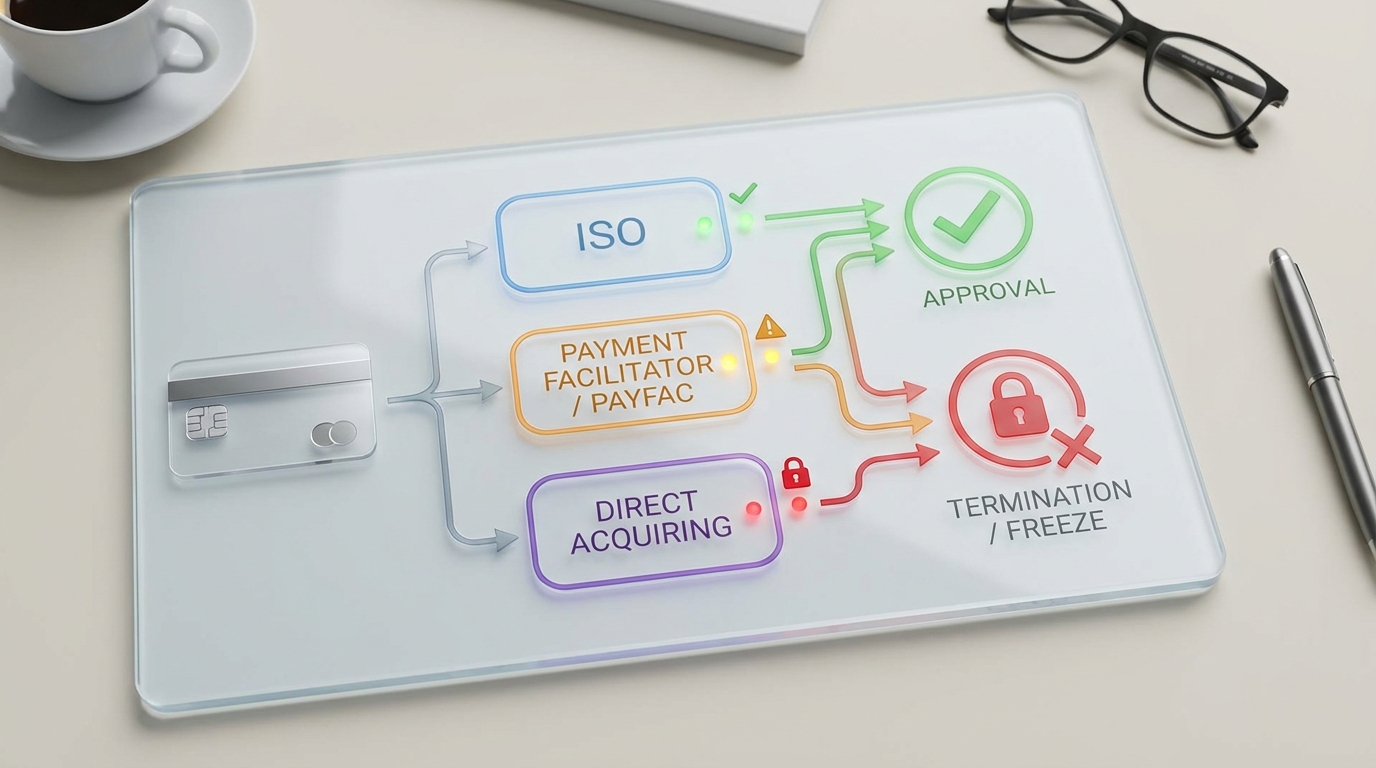
Visual explainer of ISO vs PayFac vs direct acquiring risk pathways.
Why do Stripe, PayPal, Square, and similar platforms become unstable for peptide stores?
Stripe, PayPal, Square, and many similar providers operate as payment facilitators, usually shortened to PayFacs. A payment facilitator places many businesses under its own master merchant account. This gives small merchants fast onboarding, but it also means the platform has to keep its overall portfolio inside its acquiring-bank and card-network risk limits.
Stripe’s Prohibited and Restricted Businesses policy, PayPal’s Acceptable Use Policy, and Square’s prohibited-goods rules restrict broad categories of regulated, controlled, or higher-risk products. Those policies are not a promise of individualized underwriting. A store may open an account, process for a short period, and then receive a review after transaction data, website scans, customer complaints, or internal risk monitoring identify the product category.
The notice is often brief: the account violates policy, payments are paused, and funds may be held under the provider’s agreement while liability is reviewed. There is often little useful detail and no meaningful appeal path for a category the platform has already decided not to support.
This is why a clean-looking store alone does not solve the problem. The issue is not whether the product pages look professional. The issue is whether the payment platform’s sponsor bank has accepted the category in the first place.
What is the difference between a PayFac, an ISO, and a direct acquiring relationship?
These terms get thrown around by sales reps as if they mean the same thing. They do not. Knowing the relationship model tells you who actually owns the risk decision, who can change your terms, and who can help when a review lands.
Payment facilitator: A PayFac onboards merchants as sub-merchants beneath its master account. It is fast for ordinary ecommerce, but it retains broad discretion to suspend or close accounts. This model is generally fragile for openly marketed RUO peptide catalogs.
Independent sales organization: An ISO is a payment-services intermediary that places merchants with acquiring banks and processors. A specialized ISO can submit a peptide merchant application to an acquiring relationship that is willing to review the category individually. The ISO does not erase bank risk, but it can coordinate underwriting and explain the bank’s requirements.
Direct acquiring relationship: In a direct arrangement, the merchant contracts with the acquiring bank without an ISO between them. This can provide more direct control and communication, but direct access is usually reserved for businesses with substantial volume, operating history, and a risk profile the bank already understands.
A payment gateway is separate from all three. The gateway is the technical service that sends card data from your checkout to the processor. It is not automatically your merchant account, your acquiring bank, or your approval. A gateway can work perfectly while the underlying merchant account is under review.
Underwriting documentation and compliance assets (text-free).
For most peptide operators, the practical relationship is a specialized ISO paired with an acquiring bank and processor willing to underwrite the business on its actual catalog. Managed infrastructure—the self-hosted Saleor backend and custom Next.js storefront route we build at RUO Commerce—is separate from that banking relationship, but owning the storefront makes it easier to present stable, consistent documentation when a processor asks for it.
What do underwriters actually review in a peptide merchant application?
High-risk underwriting is manual because the underwriter is trying to understand both the business and the transaction risk. A merchant application commonly includes identity and ownership records, business-registration documents, bank-account verification, expected processing volume, and prior processing statements when the merchant has them.
The website review is equally important. Underwriters commonly inspect the live storefront, not just screenshots sent with an application. They look at product names, collection pages, product labels, terms of sale, shipping language, returns language, customer-service contact details, and the checkout flow.
RUO presentation: “Research use only” should appear consistently across product pages, labels, catalog navigation, and store policies where relevant.
COA availability: A certificate of analysis, or COA, is a batch-specific laboratory document reporting analytical results such as identity or purity testing. Displaying a clear COA library gives reviewers a way to see that product documentation is organized rather than improvised.
Accurate product copy: Product descriptions should stay factual: compound name, format, storage information, lot or batch references where used, purity documentation, and research labeling.
Clear support and policies: Visible customer-service contact methods, shipping terms, refund terms, and order-status processes help an underwriter understand how disputes will be handled.
Billing descriptor clarity: The billing descriptor is the name that appears on a cardholder’s statement. It should clearly connect to the business the customer recognizes from the checkout page.
A vague descriptor creates avoidable disputes. A customer who sees an unfamiliar charge may file a dispute even when the order was delivered correctly. That kind of dispute is often called friendly fraud, but the operational fix is still straightforward: make the business name, receipt, support email, and card statement descriptor recognizable as the same company.
How long does high-risk underwriting take?
Expect a real review, not instant self-service approval. A clean application with a complete site, clear ownership records, and an acquiring path that already supports the category can move in days. Applications with inconsistent product presentation, incomplete documents, unclear supplier arrangements, or prior processing issues can take weeks or stop entirely while the underwriter asks follow-up questions.
“Instant approval” language deserves careful reading. A sales rep may mean that they can submit an application immediately, not that an acquiring bank has completed its review or assigned a usable MID. Ask what stage is actually complete: lead intake, ISO review, processor review, bank approval, gateway configuration, or live transaction capability.
A MID is the merchant identification number tied to the card-processing account. It matters because it identifies the merchant relationship inside the acquiring system. Before treating a new account as operationally stable, operators commonly confirm the acquiring bank, processor, MID, gateway connection, billing descriptor, reserve terms, and dispute-notification process.
Chargeback escalation and dispute drivers (icon-only).
What fees and reserves should a peptide merchant expect?
High-risk pricing is not just a higher card-processing rate. The agreement may include transaction fees, monthly account fees, gateway fees, chargeback fees, account-maintenance fees, and currency or cross-border fees where applicable. The important number is the total cost of accepting a settled order, not the headline percentage on the sales sheet.
A rolling reserve is the portion of each card settlement that the processor temporarily holds to cover potential refunds, disputes, or chargebacks. The agreement should explain the reserve percentage, the reserve cap if one exists, the holding period, and the release schedule. A reserve is not inherently a sign that the processor is dishonest; it is a risk-control tool. But vague reserve language can create serious cash-flow problems for a growing store.
Read the termination and funding-hold sections with the same attention you give the rate sheet. Also ask how disputes are reported, who receives retrieval requests, and how quickly the merchant can submit evidence. A low rate is not a bargain if the account has no clear support path when a review begins.
The MATCH list is another term operators should understand. MATCH stands for Mastercard Member Alert to Control High-risk Merchants. It is a database used by acquiring institutions during underwriting. A processor closure does not automatically mean a MATCH listing, but a MATCH record can make future payment applications materially harder. That is one reason to avoid misrepresenting products, business history, or processing volume on an application.
What should a peptide operator do before applying?
Prepare the store before the application, not after the first decline. Underwriters notice mismatches quickly: an RUO label in the footer but not on products, COAs that do not match catalog batches, a business name that differs from the checkout receipt, or policies copied from an unrelated store.
Make the live catalog, product labels, COA library, and customer-facing policies consistent with the RUO business model.
Keep business-formation records, owner identification, bank verification, supplier records, and any prior processing statements organized and current.
Use a billing descriptor that customers can connect to the store and customer-support contact information.
Review processor agreements for reserve mechanics, chargeback fees, termination language, and funding timelines before relying on projected cash flow.
Keep a second operational record of orders, tracking, customer correspondence, refund activity, and COA references so a dispute response does not become a scavenger hunt.
The durable approach is boring in the best possible way: disclose the category honestly, keep product presentation disciplined, use an acquiring relationship that has actually reviewed the business, and treat dispute prevention as an operating function rather than a payment-processing afterthought.
Note: This article describes common industry practices in research-use-only peptide commerce. It is not legal advice, and it does not guarantee platform, processor, or regulatory outcomes. Operators should consult qualified counsel for their specific situation.
A self-hosted ecommerce platform for high-risk products is not a shortcut around underwriting. I see it as an ownership architecture: your storefront, catalog, customer data, and payment integration logic stay portable when a vendor relationship changes.
Why is a self-hosted stack an ownership decision, not just a platform choice?
For a research-use-only (RUO) peptide store, ecommerce infrastructure has to do more than render product pages and accept orders. It has to preserve business continuity when a payment relationship changes, a hosting vendor changes its risk posture, a plugin fails, or a storefront needs to be rebuilt without losing the catalog and customer history that took years to assemble.
That is why founders in restricted categories eventually evaluate self-hosted architecture. Hosted platforms are convenient because they package hosting, checkout, updates, themes, and integrations into one service. They are also centralized. The same vendor that provides the storefront may control the application environment, constrain payment options, and retain the practical ability to suspend the account under its acceptable-use policies.
Self-hosting changes the control boundary. Your company runs the application on infrastructure it controls or leases directly. More importantly, your product data, customer records, order history, content, and integration code can be backed up, exported, and restored independently of any one commerce vendor when the stack is documented and operated properly. A processor can still decline an application, place a rolling reserve, or terminate a merchant account. A rolling reserve means a processor or acquiring bank holds back a percentage of settled funds for a moving period, often to cover chargeback exposure. A self-hosted stack does not eliminate that operational reality. It does mean a payment change does not automatically require rebuilding the entire business on a new platform.
“In restricted commerce, the storefront is not the asset. Control of the data, deployment pipeline, and checkout integration is the asset.”
This distinction is acute for stores selling research materials such as peptides. The business needs precise product information, RUO language maintained across the catalog, documentation workflows, and payment architecture that can be adapted without waiting for a platform marketplace to approve an app. It also needs disciplined operations. Owning the stack means owning patching, backups, security response, uptime monitoring, and the consequences of bad deployment decisions.
The four realistic paths are WooCommerce, Medusa, Saleor, and a fully custom build. All can be self-hosted. They differ radically in how much is already built, how payment logic is extended, how expensive change becomes, and how much engineering capability you must retain.
What does a self-hosted ecommerce platform for high-risk products actually need to do?
Before comparing frameworks, define the operational surfaces the stack must support. Many migrations fail because the team compares themes and product-page aesthetics while overlooking checkout behavior, order state transitions, fulfillment exports, and recovery procedures.
Data ownership: You need direct access to the production database, object storage, customer exports, product records, order records, and media files. A nightly database dump alone is not enough if certificates, product PDFs, and storefront assets live elsewhere.
Hosting sovereignty: Here, I mean practical control over where the application runs and how it can be restored. That control is verified through infrastructure access, contracts, backups, and key management, not by the phrase “self-hosted” alone.
Checkout flexibility: The stack must support the payment method your merchant account, gateway, and underwriting arrangement allow. That can include card processing through a gateway, bank-transfer instructions, or a separately integrated crypto payment rail. It should not assume one default platform processor is permanent.
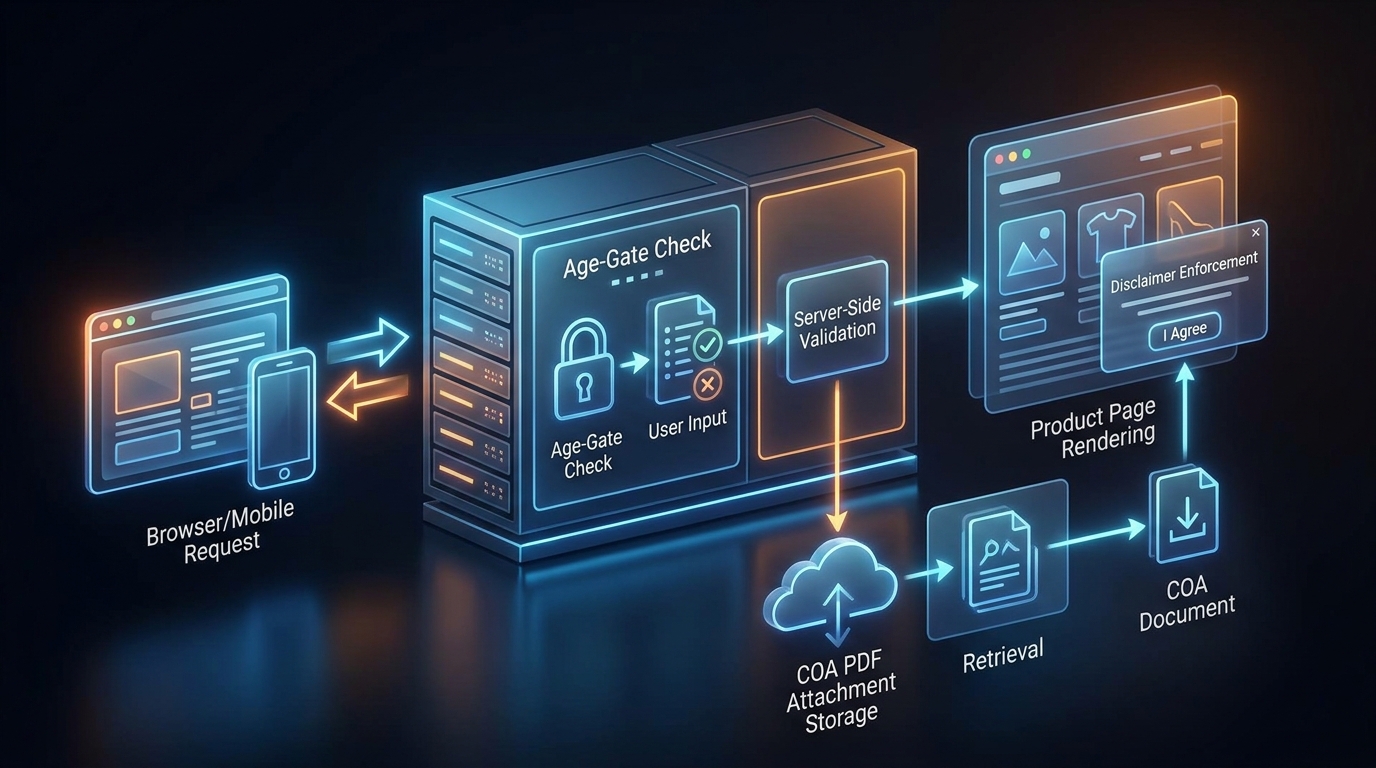
Documentation controls: Product pages should reliably display the product information, certificates of analysis (COAs), where the operator chooses to publish them, and research-use-only notices. The mechanism matters: a random PDF link added by a content editor is less reliable than a structured product-document field with publishing rules.
Age-screening workflow: A simple age gate generally records an affirmation or blocks access based on a visitor selection. It is not the same as identity verification. If your business needs more rigorous checks, that is a distinct integration and policy decision.
Security and auditability: Administrative access, payment webhooks, order exports, API keys, and deployment privileges need controls. Restricted-category stores cannot treat their checkout as a collection of unreviewed plugins with broad administrator access.
Migration readiness: The catalog, redirects, customer data, subscriptions if applicable, and order history must be exportable in formats that another system can ingest. Ownership without portability is incomplete ownership.
The architecture should separate what changes often from what must remain stable. Product content and marketing pages may change every week. Payment adapters, order accounting, customer identity, and inventory records should change more deliberately. A well-designed stack keeps these concerns separate so a landing-page update cannot accidentally disrupt checkout.
How do gateway, processor, MID, acquiring bank, rolling reserve, and MATCH list fit together?
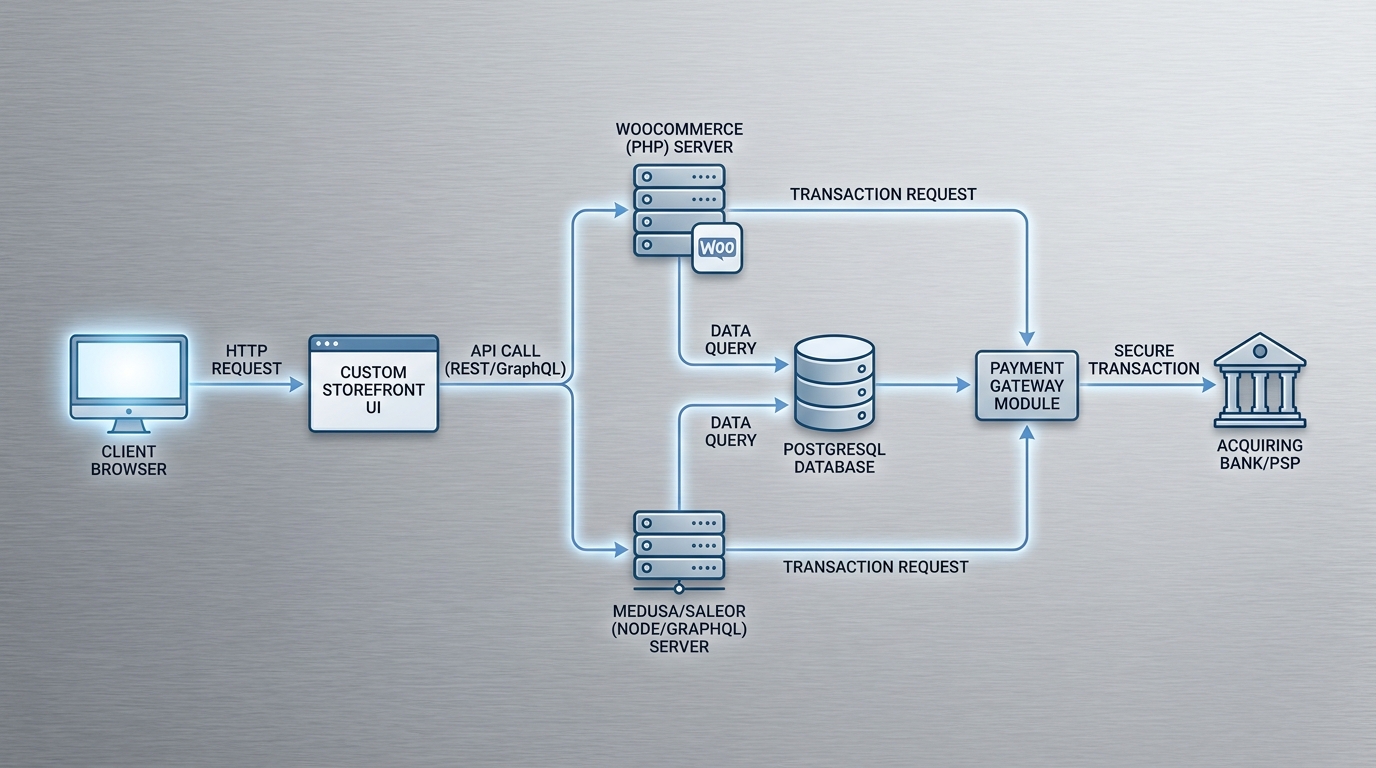
Payment terminology is frequently compressed into the phrase “payment processor,” which obscures the actual failure modes. The merchant account, often associated with a merchant identification number or MID, is the commercial relationship through which card transactions are accepted. The processor handles transaction processing. A payment gateway securely carries checkout data between the storefront and processing systems, often through a hosted field, iframe, redirect flow, or API.
The acquiring bank is the bank that sponsors the merchant account and settles card funds into the merchant relationship behind that MID. In restricted categories, the acquiring bank and the gateway may not be the same company, and that distinction matters. One party may provide the technical rails while another party decides reserve terms, review standards, or whether the account remains active.
In an iframe or hosted-field checkout, sensitive card-entry fields are served by the gateway within the merchant’s checkout page. In a redirect checkout, the buyer leaves the storefront for a processor-controlled payment page, then returns after authorization. In a direct API pattern, the storefront exchanges data with the payment provider using a tokenization workflow. The correct model depends on the provider’s integration requirements and your team’s capacity to operate the resulting security responsibilities.
Tokenization is central to payment portability. The storefront should receive a payment token, not retain raw card data. A token usually has meaning only within the vault of the provider that issued it. That creates an important limitation: moving to a new gateway may require customers to enter payment details again, because one processor’s stored token cannot necessarily be used by another. For a single-purchase RUO store, that is mainly a checkout-conversion concern. For a store with recurring billing, it can become a migration-critical constraint that must be understood before selecting any provider.
Multi-processor architecture is not simply installing two plugins and hoping one works. It requires a routing layer. That layer decides which processor receives a payment request based on configuration such as payment method, currency, order total, customer geography, product category, or processor availability. The checkout must create one internal payment attempt, record the chosen route, receive the processor response, and safely update the order state.
If a processor or acquiring bank adds a reserve, the practical effect is often cash-flow pressure rather than storefront failure. Typical rolling reserves run for 90 to 180 days, and release timing is tied to the provider agreement and batch history rather than a universal rule. If an account is terminated for risk, founders also worry about the MATCH list, short for Member Alert to Control High-Risk Merchants, which is a card-network database used by acquiring banks when evaluating merchant risk. That is exactly why I separate payment continuity from storefront continuity: even when the merchant account changes, the catalog, customer records, and deployment path should not disappear with it.
Webhook verification is where many otherwise capable stores fail. A processor may authorize a transaction at checkout but notify the commerce backend asynchronously that the payment was captured, failed, refunded, or disputed. The webhook receiver must verify the provider’s signature, reject replayed events, store the event identifier, and process events idempotently. Idempotency means that delivering the same webhook twice produces the same final order state rather than two fulfillment jobs or duplicate accounting entries.
If the webhook endpoint is unavailable during a deployment or DNS incident, the payment provider may retry for a limited period. Your system needs a reconciliation job that queries the provider’s API for unresolved payment attempts after service restoration. Otherwise, an order can remain marked as pending in the store while payment has actually settled, or it can be released to fulfillment based on a stale browser redirect rather than a verified provider event.
“A second processor is not failover until the checkout, webhook pipeline, refunds, and reconciliation procedures all work for both.”
Reference architecture for self-hosted stacks and payment-module integration
Crypto payment rails can be integrated as a separate payment method, generally through a payment service API that creates an invoice or payment session. The backend should treat confirmation as asynchronous. It should record the provider invoice ID, expected amount, selected asset if relevant, expiration time, and confirmation status. Never mark an order paid solely because a buyer reaches a “success” URL. The authoritative state must come from a signed provider callback or a reconciled API query. Refund operations, exchange-rate presentation, accounting exports, and customer-support scripts need to be designed before launch, not after the first exception.
When is WooCommerce the right fit?
WooCommerce is a WordPress plugin and remains the most familiar self-hosted entry point for many founders. It combines a mature product and order system with the largest available ecosystem of themes, extensions, content tooling, and general WordPress operators. For a small team moving off a hosted storefront, that familiarity is a real advantage.
Its strongest feature is breadth. Product pages can use established WordPress editorial workflows. Age-gate plugins can block catalog access or display an acknowledgement flow. Structured custom fields can attach COAs to product records. Disclaimer tools can inject sitewide text into designated surfaces. Payment gateways commonly arrive as installable extensions rather than custom engineering engagements.
That speed has a cost. WordPress sites often accumulate plugins because every requirement looks like a small install: caching, backup, email, shipping, analytics, checkout customization, PDF display, age gate, SEO, security, and payments. Each extension adds code, update risk, compatibility constraints, and another party that may abandon maintenance. A plugin conflict that merely breaks a blog layout is inconvenient. A plugin conflict that disables checkout or exposes an administrative route is a business incident.
WooCommerce is most effective when you impose a plugin budget. Maintain a written inventory of every plugin, its owner, renewal date, role, update history, and replacement path. Test updates in staging before production. Remove plugins that duplicate functionality. Keep custom checkout logic in a version-controlled custom plugin or child theme rather than scattering snippets through the WordPress administrator interface.
Hosting can range from managed WordPress services to a virtual private server, but the low sticker price of shared hosting is rarely the right comparison. A production store needs TLS certificate renewal, a web application firewall, database backups, offsite media storage, uptime monitoring, and a recovery path. If the checkout is commercially important, the database and uploaded certificate files should be backed up separately, with restore tests rather than mere backup-success notifications.
As a planning baseline, a VPS often starts around $20 to $100 per month, while managed hosting spans a much wider range depending on support level and infrastructure. Premium managed WordPress can start lower, but more involved managed arrangements can begin around $149 per month and rise quickly once you add operational support, storage, or traffic headroom. The point is not the exact number. The point is that hosting is usually cheaper than one preventable checkout outage.
WooCommerce fits founders who need a practical, content-heavy storefront quickly and can maintain strict extension governance. It is less attractive when checkout logic, payment routing, and custom operational workflows are central to the business model.
When does Medusa make sense?
Medusa is a headless commerce framework built around a JavaScript and TypeScript development model, typically deployed with Node.js and PostgreSQL. “Headless” means the commerce backend is separated from the storefront. The backend exposes APIs for products, carts, customers, orders, and payments; the frontend is a separate application that consumes those APIs.
That separation is valuable when your storefront needs to move independently of the commerce engine. A Next.js storefront can render catalog pages for speed and search visibility, use incremental static regeneration for products that change periodically, and call the commerce backend only for dynamic work such as cart and checkout. The design team can rebuild the visual experience without migrating order data. The operations team can change payment modules without rewriting every marketing page.
Medusa’s trade-off is that it provides fewer ready-made compliance-oriented storefront components than WooCommerce. An age-screening modal, structured certificate display, customer acknowledgement records, or bespoke order-review workflow may need to be designed and implemented by your team. That takes longer at the beginning, but it can create a cleaner result: the certificate is a first-class product attribute, for example, rather than an attachment managed by an unrelated plugin.
Payment integrations are modular, but a gateway without a maintained module becomes a development task. The work includes authorization, capture, refunds, webhook verification, error translation, dashboard configuration, and testing against provider sandbox environments where available. A developer who has only implemented the initial “pay” action has not completed a payment integration.
The practical advantage of Medusa is not just modern code. It is operational separation. When content, storefront rendering, checkout orchestration, and payment integration are distinct concerns, your team can replace one layer without rewriting everything else. That matters in restricted categories, where the payment layer may need to change faster than the product-education layer.
Medusa is a strong fit where custom workflow is more important than initial setup speed: complex product metadata, bespoke order rules, several payment methods, or a storefront experience that needs to be distinct from standard templates. It is a poor fit for a founder who expects to operate without a dependable Node.js developer or managed engineering partner.
Where does Saleor fit?
Saleor is a headless ecommerce platform built around a GraphQL API. GraphQL gives the storefront explicit control over the data it requests. Instead of making separate fixed API calls for product information, inventory, images, attributes, and pricing, a frontend can request the precise fields needed for a page. For a custom Next.js storefront, this is a clean model: the storefront queries Saleor for catalog data, renders the experience independently, and uses mutations for cart, checkout, and order actions.
Saleor is particularly well suited to stores that need a deliberate, composable architecture. Product attributes can model structured operational data. Apps and webhooks can extend behavior without directly editing the core platform. A payment integration can be handled through an app layer that communicates with a gateway, while the commerce engine retains the authoritative checkout and order states.
The benefit is not that GraphQL makes a store automatically easier. The benefit is that it makes the boundary between systems visible. The frontend owns presentation. Saleor owns commerce state. A payment app owns provider-specific logic. An email platform owns transactional delivery. When the boundary is clear, replacing one element is less likely to destabilize every other element.
Saleor requires stronger engineering hygiene than a basic WooCommerce store. It is commonly deployed using containers, with services for the Saleor application, PostgreSQL, Redis or task-processing components, and an object-storage service for media. Docker makes environments repeatable, but it does not operate them for you. Kubernetes can help larger teams manage scaling and deployments, but it adds substantial operational complexity. A small store does not need Kubernetes simply because it is fashionable; a carefully managed Docker deployment on suitable infrastructure can be the more responsible choice.
Saleor also requires a custom storefront. That is a cost, but it is also the ownership advantage. A Next.js storefront can be maintained as a separate repository, deployed independently, and designed around the exact product-education and documentation flow the store requires. The storefront is not trapped inside a theme system that limits checkout presentation or content architecture.
For many established restricted-category stores, Saleor occupies the practical middle ground between WordPress convenience and a fully custom commerce engine. It provides a mature commerce core without forcing the company to accept a closed hosted platform’s application boundary.
When is a custom build justified?
A fully custom platform means the team owns the product catalog, pricing, cart, checkout orchestration, customer accounts, order management, fulfillment integration, and administrative interfaces as application code. It can be built with almost any stack: a Next.js frontend, a Node.js or Python backend, PostgreSQL, Redis, a queue, and object storage are common ingredients. The question is not whether this can be done. It can. The question is whether building commodity commerce primitives is the best use of capital and engineering attention.
Custom architecture makes sense when your business has workflows that platforms cannot model cleanly: unusual B2B ordering, product configuration rules, internal laboratory-document workflows, proprietary inventory processes, or a payment-routing engine that must be deeply integrated with order review. It also makes sense when ecommerce itself is a strategic software capability, not merely the channel through which a catalog is sold.
The danger is underestimating the long tail. A custom cart is easy to demo. Correctly handling tax settings, refunds, partial fulfillments, inventory reservations, promotional edge cases, concurrent cart updates, abandoned payments, customer-service adjustments, exports, fraud-review queues, and accessibility is a permanent engineering commitment. The team also has to build back-office tooling that WooCommerce, Medusa, and Saleor already provide.
Custom build is not the “premium” choice by default. It is the right choice only when the cost of adapting an existing commerce engine exceeds the ongoing cost of owning a software product.
Comparative visual map of WooCommerce vs Medusa vs Saleor vs custom builds
How do WooCommerce, Medusa, Saleor, and custom builds compare side by side?
Platform
Best Fit
Payment Flexibility
Compliance and Content Controls
Primary Cost Driver
WooCommerce
Founders needing speed, familiar administration, and a broad extension ecosystem.
Strong through gateway plugins and PHP customization, but plugin quality varies.
Fastest access to age gates, document attachments, and sitewide notices.
Ongoing plugin maintenance, security work, and periodic development.
Medusa
Developer-led stores requiring custom workflows and a modern API-first backend.
High, but unsupported gateways become engineering projects.
Usually custom-built into the backend and storefront.
Initial development and retained Node.js engineering capability.
Saleor
Growing operations that want a structured GraphQL commerce core and custom frontend.
High through apps, webhooks, and provider-specific integrations.
Structured attributes and custom frontend components provide durable control.
Frontend development, container operations, and integration maintenance.
Custom Build
Businesses with truly proprietary operational requirements.
Unlimited in theory; entirely dependent on engineering execution.
Built exactly to internal requirements, with no ready-made safety net.
Permanent responsibility for all commerce and back-office features.
What actually drives total cost of ownership?
Founders often compare ecommerce platforms by monthly software fee. That is not total cost of ownership. The real cost includes build time, agency or employee dependency, hosting, managed databases, storage, monitoring, email delivery, security tooling, update labor, emergency response, and the cost of an avoidable outage.
WooCommerce can start cheaply but become expensive through accumulated extensions and brittle customization. Medusa and Saleor require more deliberate engineering up front but can reduce the number of third-party plugins that sit in the critical checkout path. Custom software has no licensing ceiling, but it assigns every future feature request, defect, and security patch to your team.
Build cost also scales unevenly. A simple self-hosted storefront can be inexpensive to launch, while a more deliberate custom implementation can move into the small-business build range very quickly. Once the project includes a custom frontend, payment modules, structured document workflows, and operational tooling, the main cost driver is usually engineering time rather than the commerce engine license.
Your deployment process is part of cost control. Production changes should flow from a version-controlled repository into a staging environment that resembles production. Staging should use separate payment credentials, separate databases, and a safe test catalog. The release process should include a rollback plan. Database migrations must be backward-compatible where possible, because rolling back application code while leaving an irreversible schema change in place can turn a minor release issue into a prolonged incident.
Backups need a recovery objective. Keep encrypted database backups, retain historical restore points, store media separately, and document the restoration sequence. Test restores on a schedule. A backup that has never been restored is an assumption, not a recovery plan. DNS should be managed with protected registrar access, multi-factor authentication, and documented records. TLS certificates should renew automatically, with monitoring that alerts before expiration rather than after visitors see a browser warning.
Monitoring should cover more than server uptime. Watch checkout error rate, payment authorization failures by gateway, webhook delivery failures, queue depth, database capacity, storefront response time, and transactional-email delivery. A store can have a healthy homepage while payment webhooks fail silently. From an operator’s perspective, that is downtime.
Should you build internally, hire a developer, or use managed infrastructure?
There is no universal winner. An internal team offers maximum day-to-day control but requires hiring, documentation, and on-call capacity. Hiring a freelancer can accelerate a launch, but the business must retain source-code access, infrastructure credentials, deployment documentation, and the ability to replace that developer. A project delivered without those controls is not owned infrastructure; it is dependency disguised as ownership.
A managed self-hosted approach sits between those models. It can provide the operational discipline of a specialized team while preserving the merchant’s control of the stack and data. At RUO Commerce, we take that route seriously: the point of managed infrastructure is not to hide the stack from the client but to make it operable without trapping the business inside our tooling.
The important test is not the vendor’s dashboard. It is whether you can obtain your database, deploy your application, access your DNS and hosting accounts, rotate integration keys, and move the stack without being forced to recreate the business from scratch.
So which path would I choose?
Choose WooCommerce when the business needs speed, content flexibility, and established extensions, and when someone will actively maintain the plugin estate. Choose Medusa when custom backend workflow is the differentiator and a Node.js engineering capability already exists. Choose Saleor when you want a serious API-first commerce engine, a custom Next.js storefront, and a cleaner separation between frontend, payments, and operational systems. Choose a fully custom build only when the business has requirements that genuinely exceed those platforms.
For restricted-category stores, self-hosting is not an argument that a company can ignore payment underwriting, security practices, or platform policies elsewhere in the stack. It is an argument for resilience. The processor relationship may change. The email provider may change. The hosting provider may change. A durable commerce architecture ensures that none of those changes automatically takes your product catalog, customer records, and ability to operate with it.
Own the infrastructure, document the operations, and design every critical integration so it can be replaced without rebuilding the company.
This article describes infrastructure and payment architecture for restricted-category ecommerce. It is not legal, tax, underwriting, or compliance advice. Platform policies, acquiring-bank decisions, gateway requirements, and reserve terms change over time, so operators commonly confirm current requirements directly with counsel and service providers before launch or migration.
To launch an RUO (research-use-only) peptide ecommerce store in 2026, build the company file, product record, and payment application before you try to market the catalog. Form and document the entity, choose infrastructure you control, prepare batch-level records, and submit an honest high-risk merchant application. A self-hosted storefront can reduce platform dependence, but it does not remove acquiring-bank, card-network, hosting, or regulatory review. Plan in months, not weekends.
The hard truth is that the first transaction is usually not blocked by your product photography or your theme. It is blocked by incomplete business documents, an unclear supply chain, product copy that creates review friction, or a payment application submitted before the website is ready for underwriting.
What does “launching an RUO peptide store” actually involve?
RUO means research use only: products are presented as laboratory research materials, with no consumer-use, therapeutic, diagnostic, cosmetic, performance, or administration language. That positioning has to be consistent across the website, product labels, customer support replies, email flows, invoices, packaging inserts, and social accounts. An RUO label by itself is not a legal shield; reviewers look at the full context of how the product is marketed and sold.
A real launch has five connected parts: an operating entity, a documented catalog and supplier relationship, a storefront you can control, payment rails that understand the category, and an internal process for keeping every public touchpoint aligned. A polished site with no merchant account is not a launch. A merchant account application with a thin, unfinished website is usually not one either.
Infrastructure does not make a difficult category disappear. It makes the category legible to the people reviewing it.
Which entity documents do processors and banks typically review?
High-risk payment underwriting is a Know Your Business review, often shortened to KYB. The processor, its sponsoring acquiring bank, and sometimes additional risk teams want to know who owns the company, where funds settle, what is being sold, and whether the business website matches the application.
An acquiring bank is the bank in the card-payment chain that sponsors the merchant account. A merchant ID, or MID, is the account identifier assigned to a merchant for card processing. These are not interchangeable with a normal business bank account. Your bank receives settlement funds; the acquiring relationship enables card acceptance.
Operators commonly assemble the following before entering underwriting:
Articles of Organization or Articles of Incorporation showing entity formation.
An Operating Agreement or equivalent ownership document showing who controls the business.
An EIN, or Employer Identification Number, used for tax and banking identification in the United States.
A dedicated business bank account in the entity’s name.
A business address, business contact details, and any applicable local or state business-registration materials.
A concise description of the catalog, fulfillment model, refund process, and intended sales channels.
Supplier invoices, testing records, or other documentation that supports the products shown on the site.
Do not treat this as paperwork to invent after the application is submitted. Reviewers compare names, addresses, ownership information, website policies, and bank details. Inconsistencies create more friction than a straightforward explanation of the business model.
Entity formation, tax treatment, licensing, labeling, and regulatory classification depend on your facts and jurisdiction. This is where qualified counsel and an accountant earn their keep. The operational point is simpler: build a document file that accurately reflects the company operating the store.
Why do hosted ecommerce platforms create risk for peptide catalogs?
Hosted ecommerce platforms give you speed, but they also control the account, checkout, data access, and often the payment relationship. That means a policy decision can affect more than checkout. It can affect your storefront, order history, customer service workflow, and payout timing at the same time.
Shopify’s Acceptable Use Policy is the clearest example of this platform-level exposure in the category. Stripe’s Restricted Businesses page similarly makes clear that certain product categories require special review or are not supported. Neither document is a promise that a particular RUO catalog will remain approved simply because it is live today.
Compliance workflow diagram (no brand/text).
The familiar failure pattern is blunt: the email says the store violates an acceptable-use policy, provides little category detail, and leaves the operator trying to recover order data and customer communication at the worst possible moment. That is not a reason to hide what you sell. It is a reason to avoid building the entire business on an account you do not control.
“Self-hosted” does not mean unreviewed. It means the storefront is not the same single point of failure as the payment account.
What storefront stack is realistic in 2026?
A self-hosted architecture separates the storefront from the hosted-platform account. WooCommerce on WordPress remains a common route because it is widely supported, flexible, and familiar to many operators. It can be a practical choice when you need a conventional catalog, documented product pages, and a checkout that can accommodate processor-required disclosures.
A more custom route uses a self-hosted Saleor backend with a custom Next.js storefront. That approach provides stronger control over storefront behavior, product-data architecture, integrations, and customer experience, but it requires more technical ownership. Managed infrastructure—this is what we build at RUO Commerce—trades a recurring operating cost for a self-hosted Saleor and Next.js stack the client controls, while shifting more of the deployment and maintenance burden off the operator.
The trade-off is not “cheap versus expensive.” It is “simple today versus controllable later.” A hosted builder can be faster for a standard catalog. A self-hosted stack asks you to own hosting, updates, backups, security, and integrations, either internally or through an operator. For an RUO catalog, that ownership can matter when you need to change checkout language, document handling, or payment connections without waiting for a platform exception.
The practical question is not which stack looks most impressive in a demo. It is which stack your team can actually maintain when underwriting asks for wording changes, when a batch document needs to be replaced, or when a payment connection has to be swapped without taking the whole storefront down.
What should every RUO peptide product page show?
A Certificate of Analysis, or COA, is a laboratory document associated with a batch that may identify the material tested and report analytical information such as the batch identifier and stated purity or assay result. A COA is not decorative content. It is part of the operating record behind the product listing.
Product-page presentation commonly includes a prominent RUO designation, the product name and format, storage and handling information supplied by the manufacturer or testing documentation, the relevant batch number, and a clear route to the matching COA. The batch shown to the customer should match the document linked from the page. If inventory changes batches, the page and fulfillment process need to change with it.
Generic RUO product page wireframe-style render.
If the page shows one batch and the shelf holds another, you do not have a copywriting problem. You have an inventory-control problem. That mismatch can spill into refund requests, support disputes, and underwriting questions about whether the website accurately reflects the goods being sold.
Operators also commonly maintain visible shipping, refund, privacy, and terms pages, plus a clear business contact method. These pages do not make a store immune from review. They make the operation easier for a reviewer to understand and easier for customers to navigate.
FDA warning letters involving peptide sellers routinely focus on product claims that position materials as unapproved drugs. In April 2026, the agency issued warning letters to online peptide sellers that paired RUO disclaimers with health, wellness, disease, or performance claims. The practical operating discipline is to remove that language everywhere, including abandoned-cart emails, affiliate copy, social captions, support macros, and image text. A clean product page does not help if the marketing archive tells a different story.
Just as important, reviewers do not look only at labels. They look at the full sales context. If the storefront, support process, and order pattern read like consumer retail rather than laboratory supply, the RUO framing becomes harder to defend operationally.
What do high-risk processors actually check?
High-risk processors evaluate more than the legal entity. They often review the live domain, product pages, checkout flow, policies, fulfillment timeline, customer support contacts, and the consistency of your application narrative. An age gate, checkout acknowledgement, and clear RUO language may be requested by an underwriter, but requirements vary by processor and acquiring bank.
No processor name should be treated as a shortcut or a pre-approval. The real decision sits with underwriting and the acquiring bank, and that decision can change as your catalog, sales pattern, or website changes. What helps most is a site that is complete, internally consistent, and easy to review.
A rolling reserve is a portion of card sales held temporarily by the processor to cover refunds and chargebacks. It is a normal part of many higher-risk merchant agreements, not a surprise afterthought. The agreement may also include higher processing costs, transaction monitoring, limits on monthly volume, or a requirement to notify the processor before materially changing the catalog or website. Reserve size and release timing are risk-based, not fixed industry constants.
Read the merchant agreement carefully before treating card processing as “solved.” Ask how reserves are calculated, when they are released, what triggers additional review, how chargebacks are handled, and whether the processor expects prior approval for new products or material changes to copy.
Crypto payment options may reduce dependence on card rails, but they create separate operational questions around customer support, reconciliation, wallet security, tax records, and conversion of funds for business expenses. Many stores explore more than one payment method because relying on a single rail leaves little room when a provider changes its risk appetite.
Operator reviewing compliance documentation.
What does a realistic month-by-month launch timeline look like?
The timeline below is a planning sequence, not a promise of approval or a legal roadmap. Underwriting and business-registration timing can extend it.
Month one: form the operating foundation. Establish the entity, organize ownership and banking documents, choose the catalog model, and collect supplier, batch, label, and COA records. Write the basic store policies and define who owns customer support, fulfillment, inventory updates, and documentation review.
Month two: build the reviewable storefront. Configure the self-hosted platform, connect the domain, build product templates, add policy pages, and establish a process for matching each live batch to its COA. Test order notifications, inventory status, refund handling, and access controls before inviting traffic.
Month three: submit for payment underwriting. Apply with a payment provider whose risk team is willing to review the category. Submit the entity file and direct the reviewer to a finished, publicly accessible site. Keep the application description aligned with the catalog and do not add unsupported claims while the review is underway.
Month four: operate toward the first transaction. Once payment access is available, run controlled checkout testing, verify settlement instructions, confirm fulfillment handoffs, and monitor support requests. Treat early orders as an operations test: product records, batch matching, shipping communication, refunds, and chargeback prevention all matter more than a launch-day traffic spike.
What usually slows this sequence down is not design work. It is missing ownership documents, unclear supplier records, unfinished policy pages, or a site that says one thing in the application and another thing in the catalog. That is why I tell founders to build for review first and promotion second.
How should you budget for the first year?
Budgeting starts with categories, not fantasy revenue projections. Fixed costs can include entity maintenance, accounting, domain management, hosting, security, storefront development, and product-document management. Variable costs can include testing, labels, packaging, fulfillment, payment processing, reserves, refunds, chargebacks, and customer support.
The most expensive mistake is often rebuilding the store after a hosted-platform or payment failure. The second is launching a catalog before documenting the inventory behind it. Spend early effort on reusable product templates, clean COA handling, a consistent support policy, and a payment file that tells the same story as your website.
Cash planning matters as much as cost planning. If part of your sales volume is held back in reserve, that is not spendable operating cash on day one. A store can look healthy on gross sales and still feel cash-constrained if the payment terms, refund exposure, and fulfillment costs were not modeled honestly.
Your first transaction is not the finish line. It is the first proof that your entity, inventory records, checkout, payment rail, and fulfillment process can operate together without contradicting one another.
The practical order is straightforward: establish the company record, document the catalog, build an ownable storefront, make the site reviewable, then approach payment underwriting with the finished operation in view. That route is slower than opening a generic online store, but it is far more honest about what RUO peptide commerce requires.
Note: This article describes common industry practices in research-use-only peptide commerce. It is not legal advice, and it does not guarantee platform, processor, or regulatory outcomes. Operators should consult qualified counsel for their specific situation.
Shopify, Stripe, and PayPal ban or restrict many peptide stores because their policies commonly classify research-use-only (RUO) peptides as research chemicals, unapproved pharmaceutical products, or regulated goods with elevated payment risk. An RUO label and a certificate of analysis (COA), meaning a batch test document, can improve store documentation, but they do not override a platform’s acceptable-use policy or a processor’s risk decision.
The email usually says some version of “your store violates our Acceptable Use Policy,” with little useful detail and a payout hold attached. That is not a random moderation event. It is the visible result of a chain involving the storefront platform, its payment partners, the acquiring bank, and card-network rules.
A peptide storefront can look professionally built and still be outside a mainstream platform’s risk appetite. The issue is not whether the site has a polished theme. It is whether every company in the transaction chain is willing to support that product category.
Why do peptide stores get banned from Shopify and Stripe?
The short answer is category classification. Stripe’s Restricted Businesses list explicitly identifies “peptides, research chemicals, and other toxic, flammable and radioactive materials” as prohibited activity. That language matters because it is a categorical restricted-business rule, not a request for a better homepage or a cleaner checkout flow.
The product prohibition can be categorical even when enforcement timing is not identical for every account. Some stores are flagged early, while others draw review after order volume, transaction patterns, or other risk signals accumulate. Either way, the underlying problem is the same: the category itself sits outside the processor’s normal risk appetite.
Stripe is both a payment technology provider and part of the acquiring chain for many businesses. An acquiring bank is the financial institution that enables a merchant to accept card payments. If a product category falls outside the acquiring bank’s risk appetite, a merchant account can be declined, paused, or terminated even when the store itself is operating normally from a technical perspective.
Shopify creates a separate but related problem. Shopify is a commerce platform, while Shopify Payments is its integrated payment product. A store can be reviewed at the platform level, the payment level, or both, and those reviews do not always happen at the same time. Shopify’s Acceptable Use Policy and payment rules restrict products that are regulated, restricted by law, require special licensing, or create heightened safety and liability concerns. Trust and Safety reviewers may classify peptide catalogues within those restricted categories.
That is why a founder can spend weeks on a Shopify build, turn on Shopify Payments, receive a few orders, and then lose access with little notice. The business did not necessarily fail at ecommerce. It selected a platform-and-payment combination whose policy structure was not built to support its catalogue.
Shopify can be a storefront decision, a payment decision, and a data-ownership decision at the same time. Treating it as only a website builder is how operators get trapped.
Why does PayPal also flag RUO peptide transactions?
PayPal’s Acceptable Use Policy separately restricts categories that include certain drugs, controlled substances, unapproved products, and products that present consumer-safety risks. Research chemical language, product names, order descriptions, support emails, and transaction metadata can all contribute to how a business is assessed.
Policy and enforcement cascade overview (illustrative, no brand logos).
PayPal is not simply a checkout button. It is a financial account with its own monitoring systems, reserves, dispute controls, and account limitations. A merchant may find that a PayPal account is limited after activity begins, even if the PayPal button was technically easy to install and early transactions settled normally.
For peptide operators, the hard lesson is that adding PayPal as a backup does not create an independent safety net. If the underlying category is restricted under PayPal’s policy, the account remains exposed to review. A second mainstream processor can create a second point of failure rather than genuine redundancy.
What do platforms and processors actually review?
Reviews are rarely limited to one product title. A reviewer or underwriting team typically looks at the entire commercial presentation: product pages, collection names, searchable metadata, lab reports, refund terms, support language, shipping policies, chargeback patterns, ownership documents, and the way a merchant describes its inventory during onboarding.
RUO means research-use-only. It is a product-positioning and labeling designation used in the research supply market. It does not act as a universal permission slip for a storefront platform, payment processor, acquiring bank, or card network. The same is true for a COA. A COA documents batch testing details such as identity, purity, lot number, and analytical method; it is valuable product documentation, but it does not change a processor’s restricted-business list.
Product titles and category labels, including compound names and “research chemical” terminology.
Product copy that drifts beyond factual research-catalogue language.
Images, labels, and downloadable documents that conflict with the site’s stated RUO positioning.
Checkout descriptors, transaction metadata, invoices, and customer-service correspondence.
Missing corporate records, unclear supplier relationships, or incomplete batch documentation.
Refund, shipping, and contact pages that appear generic, inconsistent, or incomplete.
Dispute rates and refund patterns that make an acquiring bank view future card losses as more likely.
The fastest way to create review friction is inconsistency. A footer may state “for research use only,” while a collection page, blog post, or support reply uses language that tells a different story. Underwriters and platform reviewers look for whether the business presentation is coherent, not whether one disclaimer exists somewhere in the footer.
What are rolling reserves, payout holds, and the MATCH list?
Payment risk is not limited to a simple approval or denial. A processor may impose a rolling reserve, meaning it withholds a portion of each card sale for a defined period to cover refunds and chargebacks. A reserve is not a fine, but it affects working capital immediately. It can turn an apparently healthy sales month into a cash-flow problem.
Payout holds are more severe. When an account is limited or terminated, processors may retain funds for a period under their terms to account for potential disputes, refunds, and chargebacks. In this category, operators commonly see hold periods in the 90- to 180-day range rather than immediate release. Operators should read the actual payout and reserve clauses in every agreement before relying on settlement timing for inventory purchases, fulfillment expenses, or supplier deposits.
Factual, editorial visual metaphor for compliance risk and enforcement.
The MATCH list is Mastercard’s Member Alert to Control High-Risk Merchants system. It is a record used by acquiring institutions when evaluating certain terminated merchant relationships. Placement is not automatic whenever a store is closed, but a termination for a processor-rule violation can affect later underwriting. This is why hiding the real catalogue from an application is such a damaging idea: it can turn a difficult underwriting conversation into a merchant-integrity problem.
A related term is MID, short for merchant ID. A MID is the account identifier tied to a card-processing relationship. If a prior termination becomes part of the underwriting record around that relationship, getting a later MID can become harder even if the next website looks cleaner.
Do not build your operating plan around “getting away with it” until the next review. Build around whether the processor has knowingly assessed the actual business.
What storefront routes are realistic for RUO peptide operators?
Mainstream all-in-one platforms are attractive because setup is quick: hosting, themes, checkout, and payments arrive in one package. That simplicity is real, but it also means one policy decision can remove several layers of the business at once. If the platform or its payment product restricts the catalogue, the operator has limited control over the timing or outcome of a review.
A self-hosted commerce stack separates storefront infrastructure from payment processing. That can mean a WooCommerce installation, a custom storefront connected to an ecommerce backend, or another self-managed architecture. The advantage is ownership of the storefront code, product data, hosting relationship, and payment-gateway integration. The trade-off is operational responsibility: security updates, monitoring, backups, integrations, and technical support do not disappear just because the platform logo does.
Managed self-hosted infrastructure is the middle ground for operators who need ownership without personally maintaining every server and deployment. This is the route we build at RUO Commerce: a self-hosted Saleor backend and custom Next.js storefront that the client owns, while we operate the infrastructure. It does not make a restricted processor acceptable or guarantee an underwriting result. It separates your store from a single hosted-platform policy decision.
Specialized high-risk payment providers are another distinct layer. “High-risk” does not mean unregulated, hidden, or consequence-free. It means the provider has a risk model designed for categories that mainstream processors decline. Underwriting can be slower, documentation requests can be heavier, fees and reserves may be less favorable, and approval remains the provider’s decision.
What documentation reduces processor review friction?
Serious underwriting starts with a business that can be described consistently and documented cleanly. Operators commonly prepare ownership and corporate records, bank information, supplier invoices or agreements, batch-specific COAs, fulfillment details, shipping and refund policies, product labels, and a clear explanation of their catalogue.
Three-layer risk structure (diagrammatic).
Product pages should function like a research catalogue, not like vague promotional landing pages. A useful page commonly includes the compound name, format, stated quantity, batch or lot reference where applicable, storage and shipping handling information, a link to the relevant COA, and clear RUO labeling. Copy should remain factual and should not make health, therapeutic, cosmetic, performance, or consumer-use claims.
A consistent catalogue also helps operationally. When a customer asks for a COA, the support team should be able to locate the matching batch record. When a fulfillment partner receives an order, product labels and packing records should align with the storefront. When an underwriter opens the site, the business description should match the application. Those are basic controls, but they are often the difference between a review that can proceed and one that stops at the first contradiction.
What should happen after a Shopify, Stripe, or PayPal shutdown?
First, preserve what you still control: product records, order exports, customer-service history, supplier documentation, COAs, shipping records, and accounting data. A hosted platform account is not a backup strategy. Store data should exist outside the platform before any suspension occurs.
Second, read the termination or limitation notice closely and keep the record. It may identify the relevant policy section, settlement timeline, dispute process, or documents connected to the review. Avoid treating a new domain, a different business name, or concealed product language as a recovery plan. That approach compounds risk and can make future underwriting harder.
Finally, separate the rebuild into the right sequence: catalogue and documentation first, storefront ownership second, payment underwriting third, and launch only after the pieces match. The slow part is usually not installing a new theme. It is aligning the business, the product presentation, and the payment relationship honestly enough that no one in the chain is surprised by what you sell.
If there is one lesson here, it is simple: platform convenience and payment permission are not the same thing. Treat them as separate decisions from the start, and you will make better choices about risk, ownership, and how exposed your business really is.
Note: This article describes common industry practices in research-use-only peptide commerce. It is not legal advice, and it does not guarantee platform, processor, or regulatory outcomes. Operators should consult qualified counsel for their specific situation.